
8-9 Spring Place, London.
At a glance
- Site: 8–9 Spring Place, Kentish Town, London NW5 3ER
- Client: Stamos Yeoh Architects
- Building Type: Residential – houses and apartments
- Development Size: 13 dwellings (9 flats, 4 houses)
- Gross Internal Area: 1,410 m²
- Assessment Type: Energy Statement & Whole Life Carbon Assessment (Planning Stage)
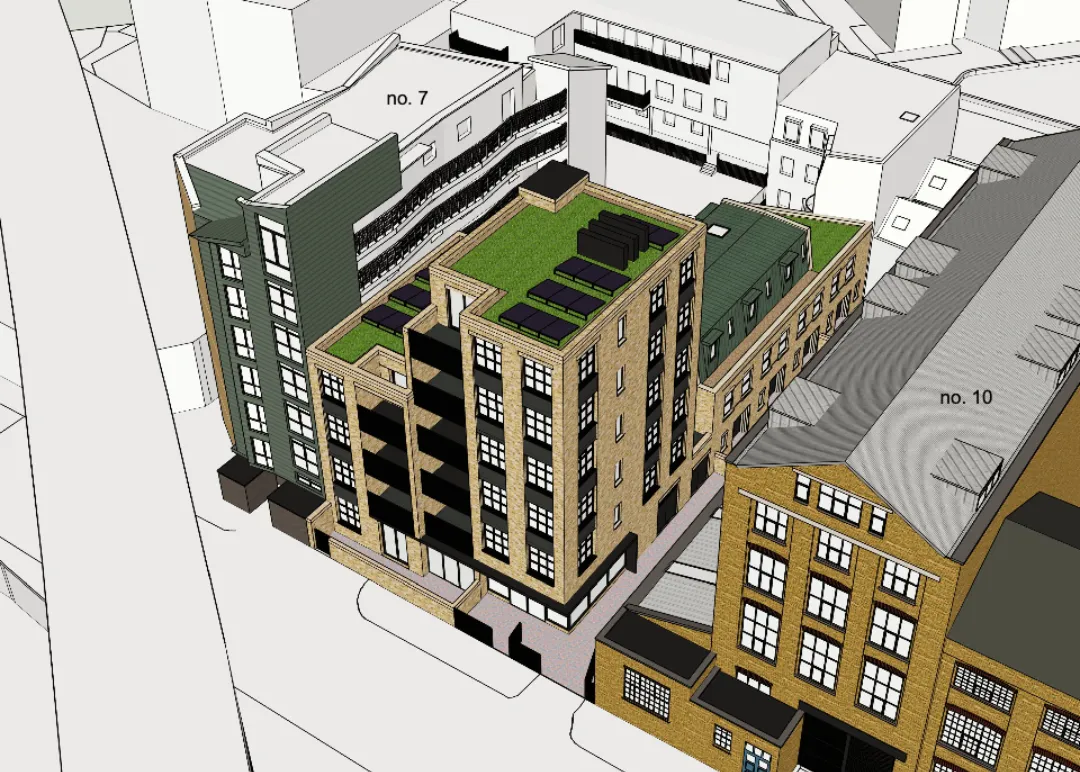
Project brief
Eteria was appointed to deliver the Energy Statement and Whole Life Carbon Assessment for the proposed residential redevelopment at 8–9 Spring Place, Camden. The scheme replaces the existing building with 13 new homes, including houses and apartments.
The brief was to demonstrate compliance with the London Plan energy hierarchy and GLA whole-life carbon policy while identifying practical measures to reduce operational and embodied carbon at planning stage.
Challenges
Overheating risk had to be assessed against future climate scenarios using CIBSE TM59, with limited scope for mechanical cooling due to roof space and acoustic constraints. At the same time, the Whole Life Carbon Assessment showed that a conventional demolition and new-build approach would exceed GLA benchmarks, driven mainly by concrete and steel.
The design team therefore had to identify realistic low-carbon material options that could significantly reduce upfront and embodied carbon without compromising structural performance, buildability or planning risk.
Results
This was managed by taking a fabric-first design, electrified heating solutions in combination with rooftop solar PV.
The improved whole-life carbon design reduced upfront carbon to 600 kgCO₂e/m² and total embodied carbon to 710 kgCO₂e/m², which is well below the GLA benchmarks.
We are focused on applying practical, forward-thinking technologies to improve the efficiency and sustainability of assets and their operations. Our goal is to support carbon reduction by using innovation blended with traditional practices to ensure a robust solution.